Claude Code auto compact: what it costs and what you lose (2026)
Claude Code auto compact fires on a per-model token boundary, not a percentage. What it costs is set by prompt cache warmth rather than context size, and a path-scoped rule does not come back afterwards until Claude reads a matching file again.
On this page
Quick answer
I spent 14 September 2026 reading how Claude Code auto compact actually works, after a long session compacted at a point I did not expect and came back having quietly forgotten a rule I rely on.
Three things turned out to be true, and none of them is what the status line suggests.
The trigger is a token boundary, not a percentage. Where it sits depends on your model and your plan, and it moves when you switch models mid-session.
What compaction costs is set by cache warmth, not by context size. The same conversation, compacted at minute three and at hour three, is not the same price. That is the opposite of the intuition, and it is the single most useful thing on this page.
What you lose is not uniform. Your project-root CLAUDE.md comes back from disk. A path-scoped rule does not, and will not, until Claude next reads a file that matches it.
The dollar figures will move. Auto compact is under active change, and there is an open regression about it right now. The mechanics below are the part that stays true.
The moment
Thursday, a long refactor, somewhere past the two hour mark. The session compacted on its own, which is what it is supposed to do. Then Claude did something the project rules explicitly forbid, in a directory that has a rule file saying so.
My first assumption was that the rule had never loaded. It had. It loaded when Claude first read a file in that directory, three hours earlier, and compaction summarised it away with the rest of the conversation.


Everything below is read from Anthropic's auto-compact window reference, its prompt caching reference and its what survives compaction table, all read on 14 September 2026. I have flagged what I checked on a running install and what I am repeating from the documentation.
Finding 1: the percentage is a fraction of a number that moves
The indicator says "context left until auto-compact". It is a percentage, so it reads like a fixed fraction of a fixed window. It is neither.
The documented boundaries are token counts, and they are per model and per configuration:
Scroll to see more
| Configuration | Compacts at |
|---|---|
| Sonnet 4.6 and Opus 4.6 without extended context | the 200K boundary |
| Opus 4.8 and Opus 5 with a 200K context window | the 200K boundary |
CLAUDE_CODE_DISABLE_1M_CONTEXT=1 set | the 200K boundary |
| Models with a native 1M window (Sonnet 5, Fable models, Opus 4.7 and later) | about 967K tokens |
| Cloud sessions | as the conversation approaches the model's limit |
| An unrecognised model ID | whatever window Claude Code assumes for that ID |
So the denominator behind that percentage is roughly 4.8x larger on a native 1M model than on a 200K one. Switch models mid-session with /model and the percentage is now measuring against a different number. It is not wrong, it is just not the invariant people treat it as.
This is also where the most-read third-party explainers drift. Page-one articles on this term describe the trigger as "around 95% of capacity", which is a reasonable mental model and is not how the docs define it. I am not linking those pages, because the point is the drift rather than a takedown of anyone in particular.
Finding 2: cache warmth sets the price, not context size
This is the one I had backwards, and it is backwards in a useful direction.
The naive model is that compacting a large conversation is a large request, because a large conversation has to be read in order to be summarised. That is half right. It has to be read. What it costs to read depends entirely on whether the prompt cache still holds it.
Anthropic's prompt caching reference, verbatim: "While the cache is warm, that request reads your prefix from the cache, so a mid-session /compact costs a fraction of what the context size suggests and spends most of its time generating the summary."
And the other side of it:
The same page, verbatim: "After a break longer than the cache lifetime, there is no cache left to read, so the summarization request reprocesses the full history as uncached input. This is why /compact costs the most when you resume an old session."
To produce a summary, Claude Code sends a separate request carrying the same system prompt, tools and history as your conversation, plus a summarisation instruction as a final user message. That request is an ordinary request. It hits the cache or it does not.
The practical shape of that:
- Compacting in the middle of active work is cheap relative to the context size, because the prefix is warm.
- Compacting the first thing after lunch is the expensive one, on exactly the same conversation.
- The turn after compaction is never the slow part. It rebuilds the cache for a much shorter summary.
Which inverts the usual advice. "Compact before it gets big" is less useful than "compact while it is still warm".
Finding 3: the cache lifetime halves when you cross your plan limit
The lifetime that decides finding 2 is not a constant either, and the way it changes is unhelpfully timed.
Claude Code assigns a TTL per request from two fixed buckets. Your interactive turns are the main conversation. Compaction, subagents, forks and session titles are everything else.
Scroll to see more
| Request bucket | Claude subscription, within plan usage | Usage credits, API key, or cloud provider |
|---|---|---|
| Main conversation | One hour | Five minutes |
| Everything else | Five minutes, except server-controlled helpers | Five minutes |
Read the first row again. On a subscription, inside your included usage, your conversation cache survives an hour of idling. The moment you go past your plan's limit and start drawing on usage credits, Claude Code drops the main conversation to the five minute TTL, because you are now being billed for that usage.
So the regime where compaction is expensive switches on at the moment you are already over budget. A twenty minute break that cost you nothing on Tuesday costs you a full uncached reprocess on Thursday, and nothing in the interface announces the change.
You can hold the hour. Set promptCacheTtl to 1h, or the CLAUDE_CODE_PROMPT_CACHE_TTL environment variable. Both take 5m or 1h and both ignore anything else. There is a separate control for the other bucket, subagentPromptCacheTtl or CLAUDE_CODE_SUBAGENT_PROMPT_CACHE_TTL. The docs give v2.1.242 or later for both.
Finding 4: three ways to move the window, and the obvious one is the weakest
You can set the auto compact boundary yourself. There are three surfaces, and their precedence is not the order you would guess.
# 1. In-session command, saves to user settings
/autocompact 500k

# 2. CLI flag, this launch only
claude --autocompact 500k

# 3. Environment variable
export CLAUDE_CODE_AUTO_COMPACT_WINDOW=500000
The environment variable wins. It takes precedence over the command, the flag and the setting, and while it is set /autocompact reports the override instead of changing anything. Type a new value into a session that has the variable exported and you get a report, not a change.
The genuinely surprising part is the other two. The /autocompact command is preempted by a higher-priority settings scope such as managed settings: it saves your value, and your session keeps the scope's window. The --autocompact flag is not preempted that way.
So the ranking, from most to least reliable, is environment variable, then flag, then command. The command is the one the docs surface first and the one most people will reach for.
Two smaller edges in the same area:
The value formats differ per surface. The command and the flag accept 200000, a k or M suffix such as 500k or 1M, and a bare number from 100 to 1000 meaning thousands, so 200 means 200,000. The environment variable accepts plain token counts only. export CLAUDE_CODE_AUTO_COMPACT_WINDOW=500k is not a smaller window. It is a malformed value.
The window is capped at the model's context window. Asking for 1M on a 200K model does not get you 1M. Accepted range is 100K to 1M. /autocompact auto returns to the model's tuned window.
Finding 5: what survives is not what you would guess
Compaction replaces your history with a summary. What comes back afterwards depends on how each thing was loaded, and that distinction is the whole finding.
Scroll to see more
| Loaded how | After compaction |
|---|---|
| System prompt and output style | Still apply |
Project-root CLAUDE.md, unscoped rules, auto memory | Re-injected from disk |
| The plan from plan mode | Re-injected from disk |
Rules with paths: frontmatter | Reloaded only when Claude next reads a matching file |
Nested CLAUDE.md in a subdirectory | Reloaded only when Claude next reads a file there |
| Files Claude read or edited | Up to five re-read, most recently modified first |
| Invoked skill bodies | Re-injected, capped per skill and in total, oldest dropped first |
| Context a hook added earlier | Summarised with everything else |
That fourth row is what bit me. Path-scoped rules and nested CLAUDE.md files are not configuration in the way the root file is. They enter the conversation as message history when their trigger file is read, so compaction summarises them away with everything else, and they come back only when a matching file is read again.
The documented fix is blunt and it works: if a rule must persist across compaction, drop the paths: frontmatter or move it into the project-root CLAUDE.md. There is also a hook escape hatch, a SessionStart hook matching the compact source, whose output Claude Code adds to the compacted context.
Two more numbers from that table worth having:
- The file re-read is capped at five, most recently modified first. A file over 5,000 tokens comes back as a path reference rather than its contents, shown as
Referenced fileinstead ofRead. - Skill bodies are capped at 5,000 tokens per skill and 25,000 total, oldest dropped first, and truncation keeps the start of the file. Which is a quiet argument for putting the instructions that matter near the top of a
SKILL.md.
Finding 6: three cheaper things than compacting
Compaction is not the only way to get room back, and it is the most expensive of the four.
/rewind truncates the conversation back to an earlier turn. The remaining history is exactly the content the cache was built from, so the next request hits an existing cache entry instead of building a new one. If you have gone down a path you want to abandon, this is strictly cheaper than compacting it.
/recap generates a summary for display in the terminal and appends it as command output rather than replacing your history, so the cached prefix stays intact. It is a reading aid, not a context operation.
/clear costs nothing at all. When you want a fresh start rather than continuity, it is free, and compaction is not.
And one thing that is not a cheaper option but is worth knowing: Claude Code also clears old tool results from context, which is a separate operation from compaction. Compaction summarises. Clearing removes. The /usage prompt cache line counts both as "expected rebuilds" rather than as cache misses, which is why a session can show rebuild activity without you having run /compact.
The one that surprised me most
Editing CLAUDE.md mid-session does nothing. The project-root and user-level files are read once at session start and held in memory. Your edit does not invalidate the cache, and it also does not apply.
It loads on the next /clear, /compact, or restart.
Which means compaction is quietly doing double duty: it is the context operation, and it is also the moment your configuration edits take effect. The docs are explicit that compaction reloads project context from disk, and that this "cache-hits only if CLAUDE.md and memory are unchanged since the session started". So editing the file and then compacting costs you the project-context cache hit as well, on top of the summarisation.
If you have ever edited a rule, watched Claude ignore it, and concluded the rule was wrong, this is the more likely explanation.
The open regression
Worth knowing before you rely on any of this: there is an open issue against Claude Code reporting that auto compact does not fire at 100% context, leaving the session stuck until the user runs /compact by hand.

As of 14 September 2026 it is labelled bug, area:core and duplicate, marked as a regression, and the reporter puts it at roughly the last twelve releases. The duplicate label is the informative part: this is a cluster, not one person's machine.
I have not reproduced it. My sessions compact on their own. But if yours are hitting the wall instead of compacting, that is a known state and not something you have misconfigured.
What I changed
Four things, in the order they were worth doing.
- Moved the two rules I actually depend on out of
paths:-scoped files and into the project-rootCLAUDE.md. That was the original bug and it took two minutes. - Set
promptCacheTtlto1h, so the expensive compaction regime does not switch on silently when I cross my plan limit. - Stopped setting the window through
/autocompactand started setting it through the environment variable, having learned the command is the surface most likely to be silently overridden. - Started running
/compactat task boundaries while the session is warm, rather than after a break. Same operation, materially different price.
I have also stopped reading the percentage as a measure of anything except "roughly how close am I". For the number that matters, /context gives a live breakdown by category, and the Prompt cache (main) line in /usage gives the hit ratio and whether the cache is warm right now, which after finding 2 is the more actionable of the two. Both need v2.1.251 or later. If you want the longer version of how the window fills in the first place, I wrote that up separately in my context window field log.
What I did not verify
This is a documentation reading plus one running install, and the split matters.
What I watched happen: a session auto-compacting, a path-scoped rule not applying afterwards, and /context and /usage reporting as described.
What I am repeating from Anthropic's documentation and did not instrument: the per-model token boundaries, the TTL table, the precedence order between the command, the flag and the environment variable, and the five-file and skill-token caps. I did not run a controlled cost comparison of a warm compact against a cold one, which is the measurement that would turn finding 2 from a documented mechanism into a number. If you have run it, I would like to see it.
Version-gated items carry their versions because the docs give them: promptCacheTtl and subagentPromptCacheTtl at v2.1.242 or later, the Prompt cache (main) line at v2.1.251 or later, the likely-cause text on cache misses at v2.1.260 or later, and compaction inheriting the session's extended thinking configuration at v2.1.198 or later.
If you only take one thing: compaction is a cache event. Time it against your cache, not against your context bar.
P.S. I spent longer working out why that rule vanished than on the refactor it interrupted. Filed under lessons that only cost you once.
Written by
Dani ReyesDani Reyes writes DevMoment field notes on AI dev workflow, tested on real work rather than demos.
Frequently asked questions
Why did auto compact not trigger when my Claude Code context hit 100%?
There is an open issue against Claude Code reporting exactly that, read on 14 September 2026. It is labelled bug, area:core and duplicate, marked as a regression, and the reporter puts it at roughly the last twelve releases, with running /compact by hand as the only workaround. The duplicate label is the informative part: it points to a cluster rather than one machine. If your sessions do compact on their own, you are not affected by it.
What percentage does Claude Code auto compact trigger at?
It is not defined as a percentage. Anthropic's model configuration reference, read on 14 September 2026, gives token boundaries per model: the 200K boundary for Sonnet 4.6 and Opus 4.6 without extended context, for Opus 4.8 and Opus 5 on a 200K context window, and whenever CLAUDE_CODE_DISABLE_1M_CONTEXT=1 is set; and about 967K tokens for models with a native 1M window such as Sonnet 5, Fable models and Opus 4.7 and later. Switching models mid-session changes the denominator the indicator measures against.
Does running /compact cost a lot on a large conversation?
It depends on prompt cache warmth more than on context size. Anthropic's prompt caching reference, read on 14 September 2026, states that while the cache is warm the summarisation request reads your prefix from the cache, so a mid-session /compact costs a fraction of what the context size suggests and spends most of its time generating the summary. After a break longer than the cache lifetime there is no cache left to read, so it reprocesses the full history as uncached input. That is why compacting costs most when you resume an old session.
How do I change the Claude Code auto compact window?
There are three surfaces: the /autocompact command, the --autocompact CLI flag, and the CLAUDE_CODE_AUTO_COMPACT_WINDOW environment variable. The environment variable takes precedence over the command, the flag and the setting, and while it is set /autocompact reports the override instead of changing anything. The command, unlike the flag, is preempted by a higher-priority settings scope such as managed settings. The command and flag accept forms like 200000, 500k, 1M, or a bare 200 meaning thousands; the environment variable accepts plain token counts only. The accepted range is 100K to 1M and Claude Code caps it at the model's context window.
Do my CLAUDE.md rules survive Claude Code compaction?
Only some of them. Anthropic's what-survives-compaction table, read on 14 September 2026, says the project-root CLAUDE.md, unscoped rules and auto memory are re-injected from disk. Rules with paths: frontmatter and nested CLAUDE.md files in subdirectories are not: they entered the conversation as message history when their trigger file was read, so compaction summarises them away and they reload only when Claude next reads a matching file. If a rule must persist across compaction, drop the paths: frontmatter or move it into the project-root CLAUDE.md.
Is there a cheaper alternative to /compact in Claude Code?
Three, per Anthropic's prompt caching reference read on 14 September 2026. /rewind truncates the conversation back to a prefix the cache was already built from, so abandoning a path you no longer want hits an existing cache entry instead of building a new one. /recap appends a summary as command output rather than replacing your history, so the cached prefix stays intact. And /clear costs nothing at all when you want a fresh start rather than continuity.
Keep reading

Claude Code context window (2026): don't turn auto-compact off, set it
Every explainer quotes a 200,000-token ceiling. Anthropic's own docs say the auto-compact window is a setting you choose, from 100K to 1M, and that Sonnet 5 compacts at about 967K. The popular fix is to disable auto-compact. There is a flag instead.

ccusage in 2026: what the Cost column actually measures
The Cost column in ccusage is a counterfactual: what your tokens would have cost at pay-per-use list prices, computed locally. On a Claude subscription it is not your bill, and ccusage's own introduction and Anthropic's own docs both say so. A field log on what the number measures, where the caveat is written, and where it is missing.
Claude Code telemetry: what redaction does not cover (2026)
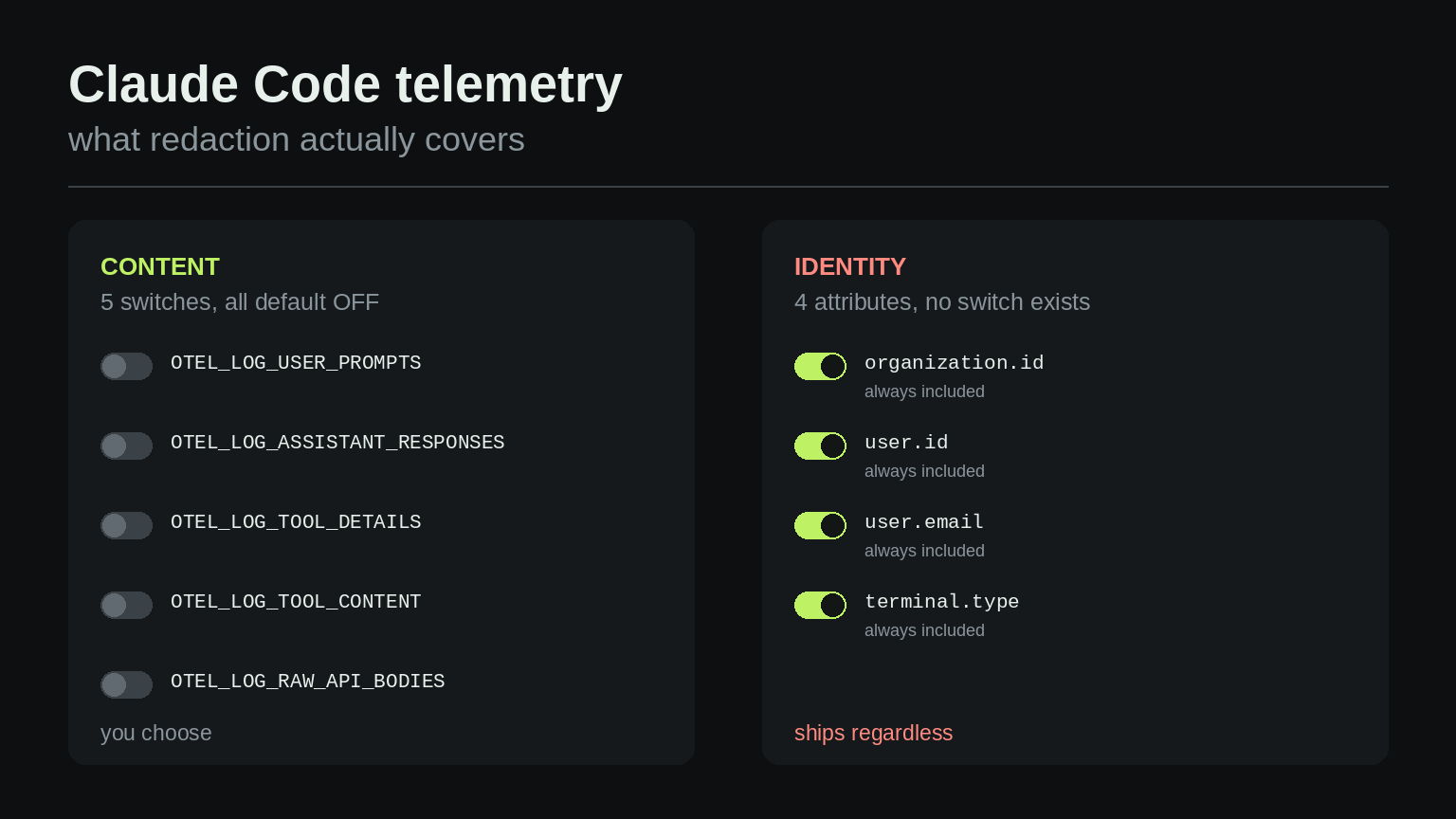
Claude Code's OpenTelemetry export redacts prompts and responses by default. It does not redact who you are. Four identity attributes ship on every datapoint with no switch to turn them off, and one environment variable quietly controls two streams.